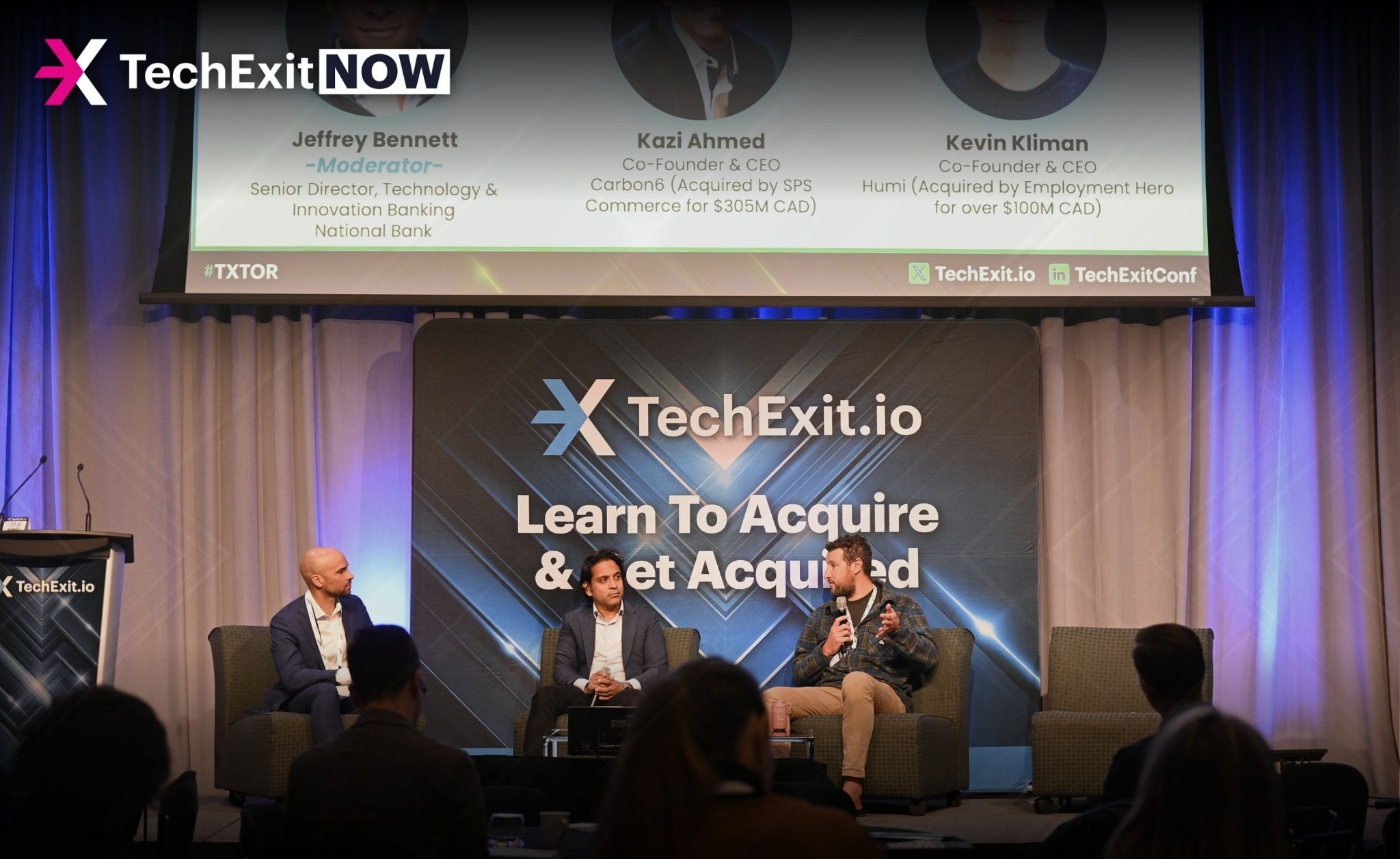
When Kazi Ahmed sold Carbon6 for $305M CAD and Kevin Kliman sold Humi for more than $100M CAD, the headlines suggested clean, decisive wins.
At TechExit.io Toronto, moderated by Jeffrey Bennett (National Bank), the two founders offered something far more valuable. They shared the choices they struggled with, the cracks that emerged inside their teams, the surprises in diligence and how the experience shaped their identities as leaders.
Both founders agreed that exits aren’t linear. Instead, they are shaped by company maturity, team stability, investor expectations, cultural fit and a founder’s ability to stay grounded when uncertainty begins to surface. Their stories revealed that selling a company isn’t just a financial event. It’s an emotional and operational test that stretches every part of a founder’s judgment.
Key takeaways:
- Company readiness matters more than market timing
- Leverage comes from not needing to sell
- A small circle protects your team and your deal
- Strategic and cultural fit determine life after the close
- Diligence exposes everything, not only what founders expect

This article explores how Kazi and Kevin navigated their exits, what surprised them and the lessons founders can apply long before buyer conversations begin. Their stories were honest, personal and deeply relevant for anyone considering an exit over the next one to three years.
1. Exit Timing Starts With The Company’s Journey, Not The Market
When asked how he knew it was time to sell Humi, Kevin gave an answer that resonated with founders across the room. It wasn’t about chasing a hot market but about reading the reality of the business.
“It was less market timing and more company journey timing,” he said. “I feel like if you fall off the venture path, but you are venture funded, there are a lot of downsides that can come.”
Humi was approaching a crossroad that many venture-backed companies face. Raise more, pursue a long path to profitability or consider a strategic partner. The sale gave the company a way to keep growing without the pressure of forcing itself back into a valuation trajectory that no longer felt aligned.
Kazi described a similar clarity. Carbon6 had momentum, strong customer signals and a clear strategy. SPS Commerce shared that strategy and wanted to accelerate it. The timing came from company alignment, not from the macro environment.
2. Leverage Comes From Not Needing To Sell
One of the most memorable moments came when Kazi described how valuation conversations unfolded with SPS. It wasn’t a tactic and instead reflected Carbon6’s strength.
“We actually told our bankers: do not return their calls. We do not want to sell.”
That pause changed everything. Within 24 hours, SPS increased its offer by 30 to 40 percent. Kazi explained why the ability to walk away matters so much.
Founders often underestimate how powerful optionality is in M&A. A profitable or high performing company creates its own leverage. It is not something that can be manufactured at the eleventh hour.
3. A Small Circle Protects Your Team & Your Deal
Kevin shared what he considers his biggest mistake of the entire process. He told too many people too early. What he hoped would create alignment instead created instability.
“The timing was massive, and I regret it massively,” he said. “We brought more people into the tent much sooner than we should have.”
The uncertainty spread quickly. People worried about their jobs, their roles and whether Humi would still be Humi after the sale. It reached a point where Kevin lost his COO in the middle of diligence.
“It ripped fissures open.”
His advice is now something he tells every founder who asks how to manage an exit.
“I would tell nobody except for one or two other people until right before the close.”
The founder’s job during M&A is to keep the company stable. A small circle gives you the space to do that.
4. Strategic & Cultural Fit Matter More Than Price
Both founders described strategic fit as a decisive factor. For Carbon6, SPS Commerce’s long term vision mirrored what Carbon6 had been pitching to the founders of the companies it acquired.
“We really saw that strategic fit and that tipped the scale toward selling.”
For Humi, cultural fit mattered just as much. Kevin described a moment when he realized Employment Hero approached people and leadership the same way Humi did.
“I learned that one of the founders wore sandals every day, and then it was pretty much a sealed deal.”
It was a humorous moment that reinforced a serious point. Founders need to be able to see themselves inside the acquiring company. The wrong culture can turn a successful exit into a painful next chapter.
5. Diligence Fixates On The Details You Think Do Not Matter
Kazi offered one of the most practical lessons of the session. The diligence process did not focus on the areas Carbon6 assumed mattered most. Instead, SPS scrutinized everything, including small product lines and legacy contracts the team had not looked at in years.
“We were a little bit surprised at some of the things the buyer focused on that we thought were not important,” he said. “Even the small things in the business ended up mattering a lot.”
For founders, this is a reminder that diligence is not intuitive. It is meticulous and detailed, and buyers will look for risk in unexpected corners. Preparing early and cleaning up historical decisions can protect valuation and speed.
Final Word For Founders
The most valuable insight from this session was that exits are not simply transactions. They are leadership tests. They require clarity, patience, emotional steadiness and the willingness to make decisions with incomplete information.
Kazi and Kevin showed that the strongest exits come from founders who run good businesses, protect their teams, choose partners who align with their vision and stay disciplined when the pressure intensifies.
These are the lessons that matter long before an offer appears.
TechExit.io: Learn how to acquire—or get acquired. Join us at TechExit.io Vancouver to hear the next wave of acquisition stories, meet the dealmakers shaping Canada’s tech landscape, and learn how to build real optionality into your company’s future.