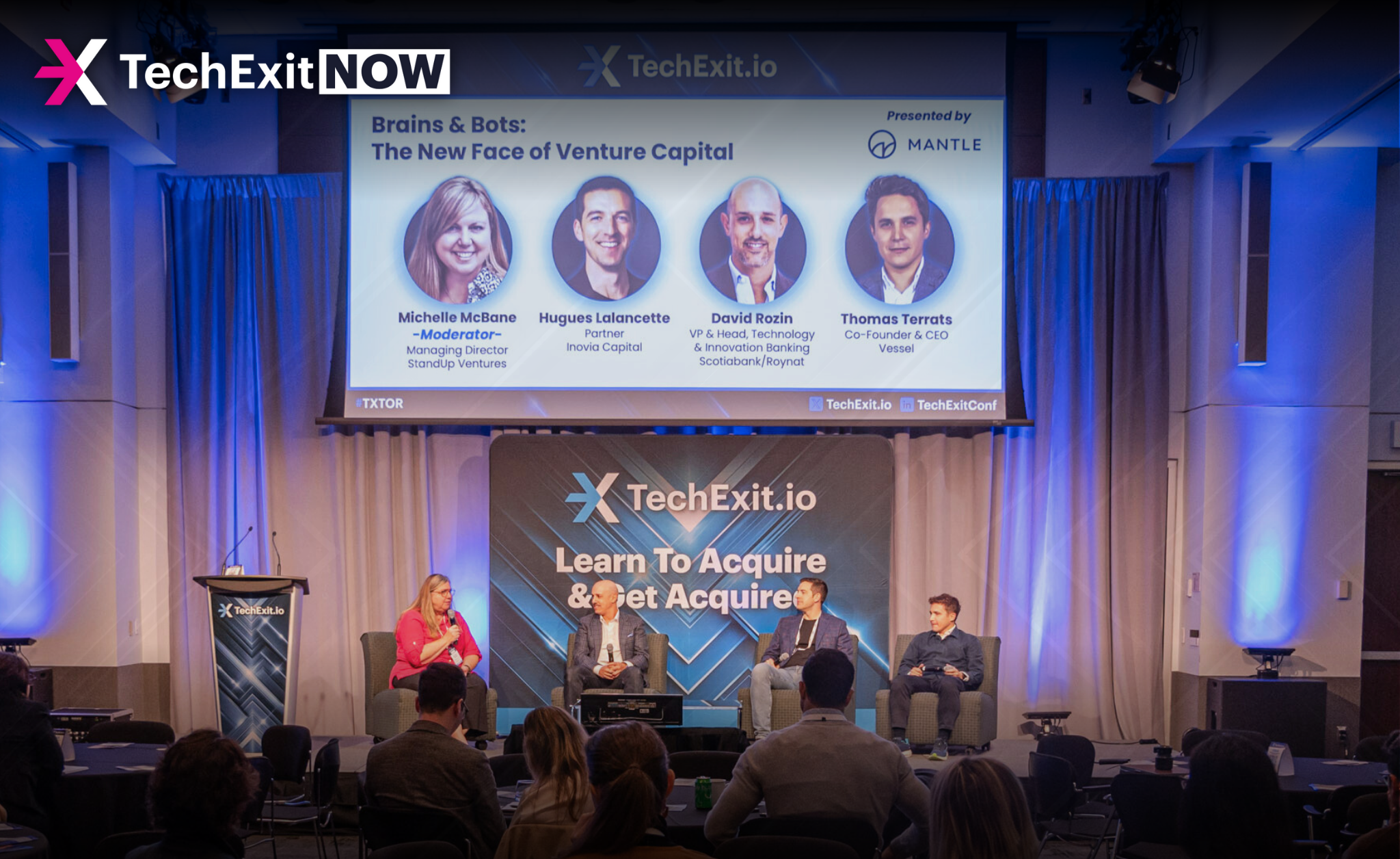
At TechExit.io Toronto, the “Brains & Bots” session brought together three people who sit at the centre of the capital stack; David Rozin (Scotiabank/Roynat Capital), Hugues Lalancette (Inovia Capital) and Thomas Terrats (Vessel), moderated by Michelle McBane (StandUp Ventures).
What unfolded wasn’t a conversation focused on AI predictions. It was a candid look at how AI is rewriting the economics of building a company, the expectations investors now have and what founders must do to stay competitive in a market that is moving faster than most companies can adapt.
The panelists described a venture world in transition: LPs holding back, funds reinventing their workflows, founders questioning whether they even need VC at all and competitive moats shrinking with every new model release.
It was a discussion grounded in lived experience (deals falling apart, valuations shifting, diligence changing) and one message came through clearly: the old growth playbook doesn’t work in the AI era.
Key takeaways:
- AI has lowered the cost of building and raised the bar for durability
- Growth expectations for AI-native companies now stretch far beyond SaaS norms
- Retention has become the ultimate signal of resilience against model disruption
- AI greenwashing is a deal-killer; transparency matters more than narrative
- Canada faces an inflection point that will determine its role in the global AI economy

This article explores how the panelists see venture capital evolving, what’s reshaping investor expectations and the practical lessons founders can use as they build in an environment defined by speed, volatility, and competition.
Their insights offer founders a new way to think about capital strategy, defensibility and leadership in the ever-changing AI era.
1. AI Is Challenging The Traditional Value Of Venture Capital
Michelle opened with a story many founders will recognize: a solo builder using AI tools to reach real revenue with almost no external capital. David’s view was that this wasn’t an exception, but a sign of how the economics of company-building are changing.
“The cost of building a company just continues to come down… the ability to turn on revenue is so easy… if you can reinvest that capital into your own business, the question becomes what do I need to take VC capital for?” — David Rozin
Lower startup costs, abundant information, repeat founders and now AI-driven output mean founders can get further before raising money or decide not to raise at all.
Venture capital still has a role, but not the same one it held for the past decade. As Hugues added:
“You’ll always have founders that want to put the pedal to the metal and go faster.” — Hugues Lalancette
The message to founders: Capital is now optional, acceleration is not.
2. The Challenge Is No Longer Finding Startups—It’s Finding The Durable Ones
Hugues put it plainly:
“The problem we have right now is not finding companies. It’s figuring out which of the 50 AI ERP companies will break out.”
AI has made it extremely easy to build a product, launch a company and show early traction. But defensibility is eroding faster than ever.
The question investors now ask, and founders must be prepared to answer, is far more uncomfortable:
“Is your zero to ten million going to get wiped at the next iteration of ChatGPT?” — Hugues
This is the new durability test.
A company can hit $10M ARR and still be one model update away from obsolescence. Founders can no longer assume that early momentum equals long-term defensibility. Instead, they must build a moat that survives the next release cycle, not the last one.
3. Growth Expectations Have Been Rewritten For AI-Native Companies
The familiar SaaS formula (triple, triple, double, double) used to anchor expectations for top-performing companies. That era is gone.
Thomas explained the new reality:
“Some companies have proven that you can 10x very, very quickly… that’s where the bar is today.” — Thomas
AI-native companies can scale faster with fewer people because distribution, sales and success functions become dramatically more efficient:
“With AI… you get a lot more productivity on the sales front, on customer success, on marketing.” — Thomas
For founders, this creates both opportunity and pressure: The ceiling is higher but so is the expected speed to reach it.
4. Retention Has Become The Single Most Important Metric
Growth still matters, but investors have shifted focus. Retention, especially gross retention, is now the strongest indicator of long-term value.
Hugues summarized the shift:
“Investors pivot to gross retention to test what that durability is going to be.”
Retention exposes whether customers genuinely rely on the product or simply tried it during an AI hype cycle. It reflects stickiness, utility and resilience against competitive or model-driven disruption.
If growth can be manufactured, retention is the truth.
Founders preparing for a raise or an exit should expect buyers and investors to start there, not with revenue multiples.
5. AI Greenwashing Is A Deal Killer. Transparency Wins.
David warned founders against overstating their AI maturity:
“If you are presenting yourself as an AI-first company… it can be transparent. It’s better to be transparent about where you are on that AI journey.” — David
Buyers are now skilled at separating genuine AI advantage from marketing veneer. In fact, AI capabilities are becoming a primary diligence track. Hugues described an acquisition where:
“The private equity fund went all in on diligence on a single AI feature.”
Founders need a crisp answer to: How does AI give us an advantage today, not eventually?
Vague roadmaps or inflated claims won’t survive diligence.
Bonus Insight: Canada’s Place In The AI Race Is At A Crossroads
This was one of the most candid parts of the conversation. The panel agreed: Canada has the talent and research but lacks the urgency.
Thomas didn’t soften his view:
“The AI wave will amplify the gap between the winners and the losers… for us it’s a matter of survival in many ways.” — Thomas
David added that Canada’s biggest challenge is founder migration south and a slower domestic market:
“The pace at which Canadian founders are moving south… that to me is a real concern.” — David
Canada’s opportunity is real, but it requires founders, investors, and institutions to lean in harder, move faster, and take more risk.
Final Word For Founders
The panel made one thing clear: AI has rewritten the rules of venture capital and the rules for building a valuable company.
Founders who succeed in this market will be the ones who:
- Focus on durability rather than early traction
- Invest in efficiency and prove real AI leverage
- Treat retention as the ultimate signal of value
- Build transparent AI strategies, not marketing stories
- Move fast enough to stay ahead of the next release cycle
This is not about riding a wave. It is about building a company that can survive it.
TechExit.io: Learn how to acquire—or get acquired. Join us at TechExit.io Vancouver to hear the next wave of acquisition stories, meet the dealmakers shaping Canada’s tech landscape, and learn how to build real optionality into your company’s future.