There’s a point in every company’s growth where the job fundamentally changes.
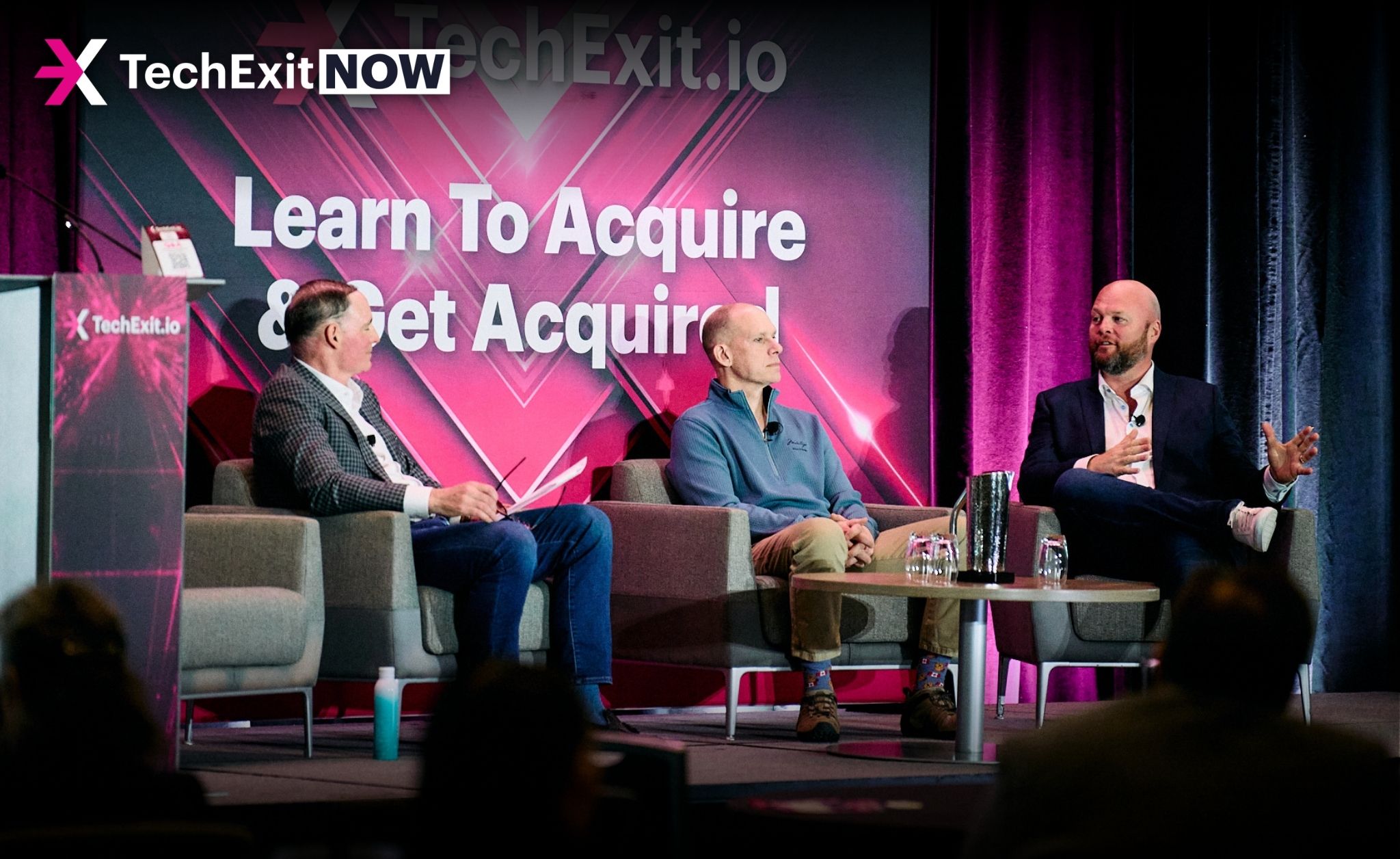
At TechExit.io, moderator Mark Longo (Osler) sat down with Jack Newton (Clio) and Jeff Shiner (1Password) to talk about what it really looks like to lead through that transition, from early traction to global scale.
Both have built category-defining companies from Canada. Both have navigated acquisitions, global expansion and the pressure that comes with operating at a completely different level.
What came through clearly is that scaling a company is inseparable from scaling yourself as a leader.
Key takeaways:
- Leadership shifts from doing to aligning and deciding
- M&A works best when tied directly to product and strategy
- Integration and culture require deliberate, early effort
What follows is a closer look at how experienced CEOs think about growth, decision-making and building companies that can compete globally.

The Job Changes Faster Than You Expect
One of the most honest moments came when Jeff reflected on what changes as a company grows.
“You stop doing all the fun stuff,” he said. “You start talking to bankers a lot more.”
But the real shift runs deeper than that.
Early on, founders are involved in everything but over time, that becomes impossible.
Jeff described how the focus moves toward ensuring the right people are making decisions rather than making those decisions yourself.
“You start to realize there are people far better at their roles than you’ll ever be,” he said. “Your job is to make sure they’re operating in a way that moves the company forward.”
For many founders, that transition is less about delegation and more about trust.
From Hands-On to High-Level Thinking
Jack described a similar evolution through a different lens.
He pointed to a clear inflection point when a company grows beyond roughly 150 people.
“Once you go beyond that number, you’re in a different place,” he said. “You stop recognizing people in the elevator.”
From there, leadership becomes more abstract.
Jack compared it to programming languages. Early on, you are close to the code, as the company scales, your role moves further away from execution and closer to long-term thinking.
“At 2,000 people, I’m spending most of my time on long-term strategy and the big bets we’re making,” he said.
The challenge is keeping everyone aligned as the organization expands.
“If you let everyone go in their own direction, it’s like summing random vectors,” he explained. “The result is zero.”
How Great Leaders Make Build vs Buy Decisions
Both CEOs have used acquisitions as part of their growth strategy but neither approaches M&A as a purely financial exercise.
Jeff laid out a clear framework.
“Partner when it’s not core to your strategy,” he said. “If it is, you need to own it, either by building or buying.”
From there, the decision comes down to speed, cost, talent and how critical the capability is to the product.
Jack described how Clio applies that thinking in practice.
Most of Clio’s acquisitions have been tied directly to its product roadmap. The goal is not financial arbitrage but delivering value to customers faster.
“We look for opportunities to pull our roadmap forward,” he said.
That approach led to Clio’s acquisition of vLex, which he described as a much bigger strategic shift.
“We saw this as an existential moment,” Jack said. “Staying on our previous path felt uncertain. This was about transforming the company.”
Relationships Often Drive The Best Deals
One of the more practical insights came from how Clio sources acquisitions.
Rather than relying only on outbound search, many of Clio’s deals have come from companies already in its ecosystem.
“Five of our six acquisitions came from integration partners,” Jack said.
That gives the team a clear advantage. They can see how products perform, how customers respond and how the companies operate before any formal process begins.
“You get to see what’s getting traction and what the retention looks like,” he explained.
It turns M&A from a cold process into a continuation of an existing relationship.
Integration Starts Before The Deal Closes
Both leaders were clear that acquisitions don’t succeed on paper, they succeed through execution.
Jeff emphasized the need to invest heavily in integration.
“You have to put more emphasis on it than you think,” he said.
In practice, that often means dedicating senior leadership time and integrating teams gradually.
He also pointed out the importance of learning from the acquired company.
“Don’t force them into your culture,” Jeff said. “Look at what made them successful.”
Jack took a slightly different approach with Clio’s vLex acquisition.
“We started integration before the deal closed,” he said, describing how leadership teams came together months in advance.
He also emphasized the importance of acting quickly once the deal is complete.
“You never want to defer integration,” Jack said. “There’s no such thing as an arms-length acquisition.”
Decision-Making Breaks Before Structure Does
As companies grow, decision-making becomes one of the first systems to fail.
Jeff described how early-stage companies operate with full transparency and group decision-making.
“You can’t allow everybody to be part of every decision as you scale,” he said.
Without clear ownership, even small disagreements can stall progress.
Jack agreed and noted that many companies struggle to move away from consensus-driven decision-making.
At scale, speed and clarity matter more than universal alignment.
Staying Connected Gets Harder (And More Important)
One of the more practical leadership habits came from Jeff’s approach to staying connected to his team.
“I tell everyone to reach out to me if they think I can help,” he said.
Even at scale, that direct line creates visibility into what’s actually happening across the company.
It also builds trust.
“You hear snippets from across the business that you wouldn’t hear otherwise,” he said.
For leaders operating at scale, those small signals often matter more than formal reports.
Final Word For Founders
Scaling a company changes the role of the founder in ways that are difficult to anticipate.
What starts as building a product becomes aligning an organization. What begins as making decisions becomes creating the conditions for others to make them well.
Jack summed it up through the lens of culture.
“Your culture is what you recognise and reward,” he said.
That becomes the foundation for everything else, how decisions get made, how teams operate and how the company grows over time.
For founders aiming to build at scale, the work is not just building the business. It’s becoming the kind of leader that the next stage of that business requires.
TechExit.io: Learn how to acquire or get acquired. Join us in our newest TechExit.io Calgary as we continue exploring how founders can build companies that command strong outcomes in today’s market.